
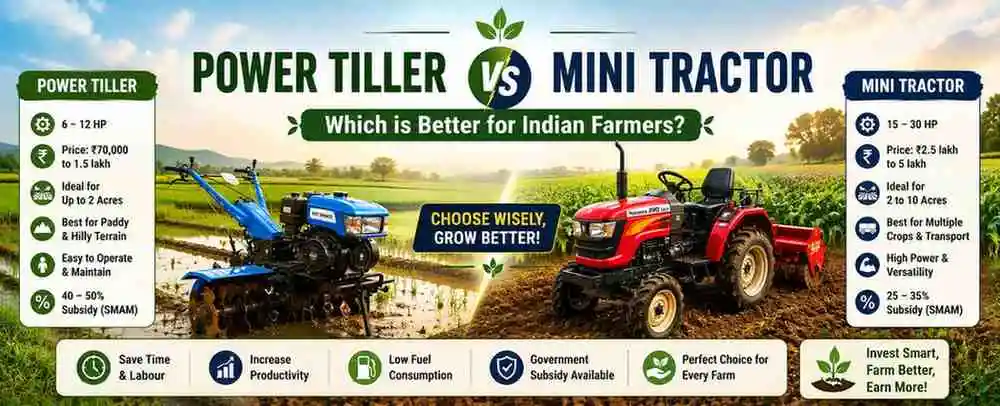
A power tiller is better for farms under 2 acres, hilly terrain, paddy fields, and tight budgets (Rs. 70,000 to 1.5 lakh). A mini tractor is better for farms above 2 acres, flat land, multiple crop types, and farmers who also need transport — though it costs Rs. 2.5 to 5 lakh. For most small and marginal farmers in India, the right choice depends on farm size, terrain, and whether you qualify for a state subsidy.
This guide compares both machines across every factor that matters — power, cost, fuel, terrain, attachments, subsidy, and resale value — so you can make the right decision without wasting money.
Power tiller vs mini tractor — complete comparison
| Factor | Power Tiller | Mini Tractor |
| Engine power | 6 to 12 HP | 15 to 30 HP |
| Price (new) | Rs. 70,000 to 1.5 lakh | Rs. 2.5 lakh to 5 lakh |
| Ideal farm size | Up to 2 acres | 2 to 10 acres |
| Fuel consumption | 0.5 to 0.8 L/hour | 1.5 to 2.5 L/hour |
| Operator required | 1 person — walks behind | 1 person — seated |
| Terrain suitability | Excellent — hilly, narrow, terrace farms | Good — flat to moderate terrain only |
| Attachments | Rotavator, weeder, thresher, pump | Rotavator, cultivator, trailer, sprayer |
| Transport use | Not suitable | Yes — trailer attachment for goods |
| Maintenance | Simple — farmer can self-repair | Needs mechanic for most repairs |
| Subsidy (SMAM scheme) | 40 to 50% | 25 to 35% |
| Resale value | Low — limited buyer pool | High — Mahindra, Sonalika hold value |
| Best for | Small, hilly, water-scarce farms | Multi-crop, flat farms, transport need |
Subsidy rates under SMAM (Sub Mission on Agricultural Mechanisation) vary by state and farmer category. SC/ST farmers get additional 10% top-up in most states. Always verify current rates at your district agriculture office before purchasing.
What is a power tiller and what can it do?
A power tiller (also called a walking tractor) is a single-axle, 6 to 15 HP diesel-powered machine operated by a farmer walking behind it. It is the most affordable mechanised tillage option for small farms in India.
What tasks can a power tiller do?
- Primary tillage: Ploughing and soil turning using rotary tiller attachment
- Secondary tillage: Harrowing and bed preparation
- Paddy puddling: Waterlogged field preparation — power tiller excels here vs any tractor
- Weeding: Inter-row weeding attachment available for vegetable farms
- Water pumping: Belt-driven centrifugal pump for irrigation
- Threshing: Paddy and wheat threshing with thresher attachment
- Transportation (limited): Small trailer attachment — max 300 to 500 kg load on flat road
Where power tiller works best in India
- Paddy farming in West Bengal, Odisha, Assam, and coastal Karnataka — waterlogged puddling is its strongest use case
- Hilly and terrace farms of Northeast India, Himachal Pradesh, and Uttarakhand — too narrow for any tractor
- Vegetable farms with 60 to 90 cm row spacing in Maharashtra and Gujarat
- Urban and peri-urban micro farms under 1 acre
Key limitation: Power tiller is slow — field capacity is 0.1 to 0.2 acres per hour vs 0.4 to 0.8 acres per hour for a mini tractor. On a 3-acre farm, this difference adds up to significant extra time per season.
What is a mini tractor and what can it do?
A mini tractor is a 4-wheel tractor in the 15 to 30 HP range — smaller and lighter than a standard tractor (35 HP+), but significantly more powerful and versatile than a power tiller. It is designed for small and semi-medium farms of 2 to 10 acres.
What tasks can a mini tractor do?
- Primary and secondary tillage with rotavator, disc harrow, cultivator
- Sowing with seed-cum-fertilizer drills
- Spraying with tractor-mounted boom sprayer — covers 3 to 5 acres per day
- Transport: Trailer attachment — carry up to 2 to 3 tonnes on farm roads
- Harvesting support: Pull reaper-binder or combine in larger setups
- Orchard work: Narrow-track models like Mahindra JIVO fit between tree rows
Where mini tractor works best in India
- Maharashtra, Punjab, Haryana, and UP where farm sizes average 2 to 5 acres
- Multi-crop farms needing different attachments across seasons
- Farmers who also need to transport produce to mandi — trailer pays for itself
- Contract farming situations where the machine earns income from neighbour fields too
Important: Mini tractors are not suitable for waterlogged paddy puddling — wheels sink and damage the paddy field structure. Use a power tiller for puddling, even if you own a mini tractor.
Which one should you buy? — Quick decision guide
Use this table to decide based on your specific situation:
| Choose Power Tiller if… | Choose Mini Tractor if… |
| Farm is less than 2 acres | Farm is 2 acres or more |
| Terrain is hilly or has narrow rows | Land is mostly flat |
| Budget is under Rs. 1.5 lakh | Budget allows Rs. 2.5 lakh and above |
| You grow paddy in waterlogged fields | You need transport in addition to tillage |
| You want to repair machine yourself | You qualify for tractor subsidy scheme |
| No road access for tractor movement | You grow multiple crops needing attachments |
Best power tiller and mini tractor models in India (2025)
| Type | Model | HP | Price (approx) | Best For |
| Power Tiller | VST Shakti 130 DI | 13 HP | Rs. 1.10 L | Paddy, flat farms |
| Power Tiller | Kirloskar Mega T 15 | 15 HP | Rs. 1.25 L | Vegetable farms |
| Power Tiller | KAMCO Power Tiller KMB 651 | 6.5 HP | Rs. 75,000 | Hilly terrain, small plots |
| Mini Tractor | Mahindra JIVO 245 DI | 24 HP | Rs. 3.60 L | Orchard, 2-5 acre farms |
| Mini Tractor | Sonalika GT 20 | 20 HP | Rs. 3.10 L | Budget, small farms |
| Mini Tractor | Farmtrac Atom 26 | 26 HP | Rs. 4.00 L | Row crops, vegetables |
VST Shakti and Kirloskar are the two most trusted power tiller brands in India with the widest service networks. For mini tractors, Mahindra has the best resale value and dealer reach — important for farmers in rural areas.
Which machine costs less to own over 5 years?
Power tiller — 5 year cost estimate (1 acre farm)
- Purchase price: Rs. 90,000 (after 40% subsidy on Rs. 1.5 lakh model)
- Annual fuel cost: Rs. 8,000 to 12,000 (0.6 L/hour x 200 hours/year x Rs. 90/L)
- Annual maintenance: Rs. 3,000 to 5,000
- Total 5-year cost: Approx. Rs. 1.55 to 1.90 lakh
Mini tractor — 5 year cost estimate (3 acre farm)
- Purchase price: Rs. 2.00 lakh (after 35% subsidy on Rs. 3.10 lakh Sonalika GT 20)
- Annual fuel cost: Rs. 18,000 to 25,000 (2 L/hour x 150 hours/year x Rs. 90/L)
- Annual maintenance: Rs. 6,000 to 10,000
- Resale value after 5 years: Rs. 1.20 to 1.50 lakh (Mahindra/Sonalika)
- Net 5-year cost after resale: Approx. Rs. 1.80 to 2.20 lakh
On a per-acre basis, a mini tractor on a 3-acre farm works out cheaper than a power tiller — the higher purchase cost is offset by speed, versatility, and strong resale value. On a 1-acre farm, power tiller wins on total cost of ownership.
Subsidy options for power tiller and mini tractor in India
- SMAM Scheme (Sub Mission on Agricultural Mechanisation): Power tillers get 40 to 50% subsidy; mini tractors get 25 to 35% — available in all states
- SC/ST farmers: Additional 10% subsidy on top of SMAM in most states
- Women farmers: Additional 5 to 10% in several states including Maharashtra and MP
- How to apply: Visit your district agriculture office or apply online via your state’s agriculture department portal — e.g., MahaDbt for Maharashtra farmers
- Important: Purchase only from empanelled dealers — non-empanelled purchases are not subsidy-eligible
Internal link: See our complete guide on Govt Schemes for Farmers 2025 for SMAM eligibility and application steps.
Final Verdict
Power tiller and mini tractor serve different farmers — one is not universally better than the other. If you farm under 2 acres on any terrain, grow paddy, or have a budget under Rs. 1.5 lakh, choose a power tiller. If you farm 2+ acres on flat land, need transport, or grow multiple crops requiring different attachments, invest in a mini tractor — the subsidy and resale value make it worthwhile long-term.
When in doubt, use your district’s Custom Hiring Centre (CHC) to rent both machines for a season before committing to a purchase — real farm experience with each machine is the best guide.
Frequently Asked Questions
Can a power tiller replace a tractor for a 3-acre farm?
Technically yes, but it is not efficient. A power tiller covers 0.1 to 0.2 acres per hour — on a 3-acre farm, full tillage takes 15 to 30 hours vs 4 to 6 hours for a mini tractor. If your budget is limited, renting a mini tractor from a Custom Hiring Centre (CHC) for seasonal work while owning a power tiller for routine tasks is a cost-effective middle path.
Which power tiller brand is best in India?
VST Shakti is the most popular and trusted power tiller brand in India, followed by Kirloskar and KAMCO. VST has the widest service network across South India and Maharashtra. For hilly regions of Northeast India and Himachal Pradesh, KAMCO (Kerala Agro Machinery Corporation) models are preferred due to their lighter weight and hill-terrain optimisation.
Is a mini tractor good for paddy farming?
A mini tractor is useful for paddy farming on dry land preparation but is NOT suitable for wet puddling in waterlogged paddy fields. For puddling, a power tiller with cage wheels is the right tool. Many paddy farmers in Bengal and Odisha own both — a power tiller for puddling and hire a tractor for dry land operations.
How much does a power tiller cost per hour to operate?
A power tiller in India costs approximately Rs. 55 to 80 per hour to operate — including fuel (0.6 L diesel at Rs. 90/L = Rs. 54) plus wear and maintenance. Custom hiring rates for power tillers at CHC centres are typically Rs. 200 to 350 per hour depending on the state and attachment used.
What is the life of a power tiller in India?
A well-maintained power tiller from a reputed brand like VST or Kirloskar lasts 10 to 15 years in Indian farm conditions. Key maintenance tasks that extend life: daily air filter cleaning, engine oil change every 100 hours, gearbox oil check monthly, and belt inspection before every season. Avoid overloading beyond rated HP — the most common cause of early engine failure.